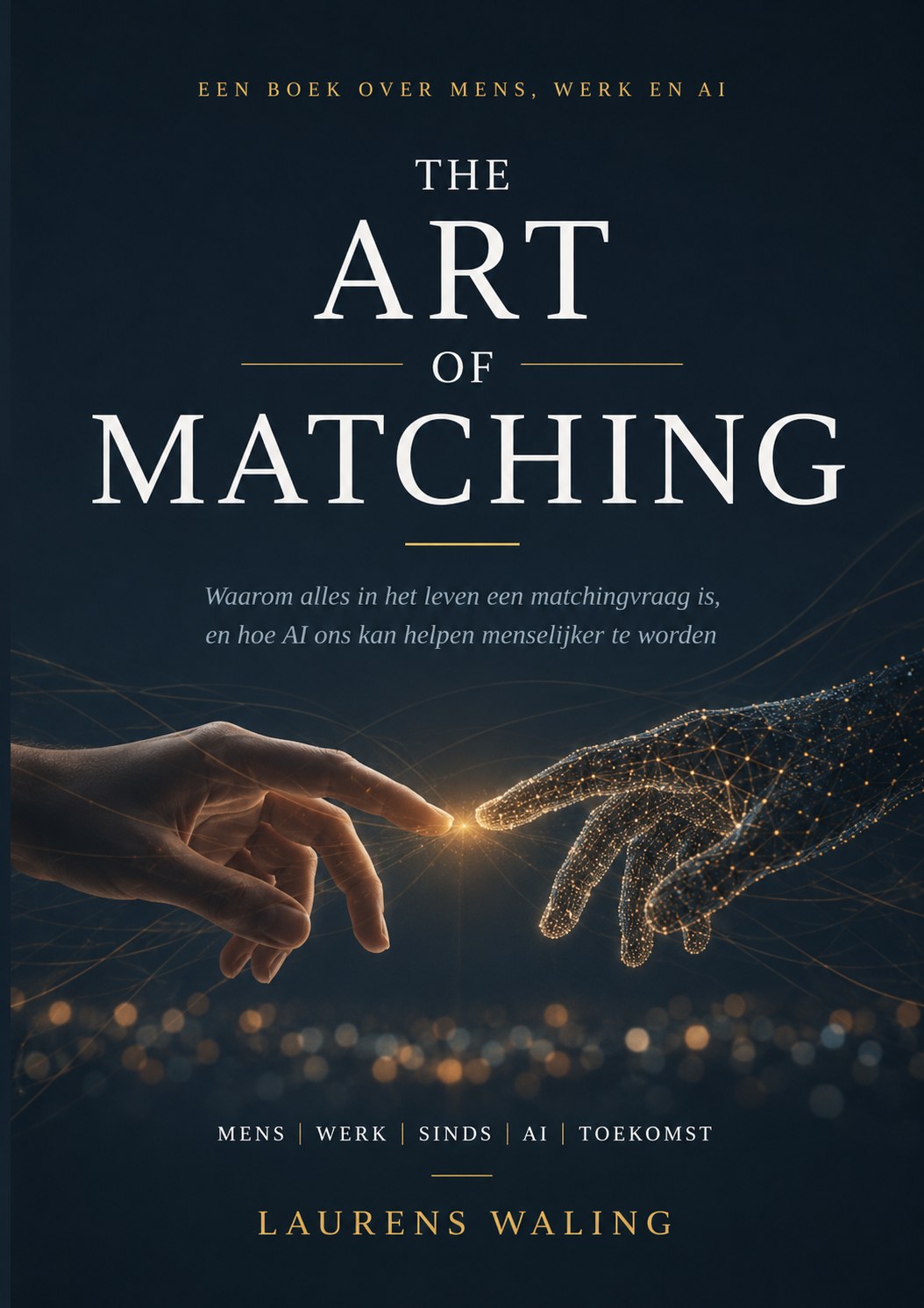
What if the quality of our society is mostly determined by the quality of the matches we make? This book is my exploration of that question, and you can already read along.
In my work at 8vance and on hundreds of stages, I see the same pattern: organisations rarely lack talent, money or ambition. What they lack are good matches, between people and work, between supply and demand, between technology and human value.
The Art of Matching explores what it takes to make those matches better: what role AI plays, what organisations need to let go of, and what it asks of leadership and humanity. The book is still being written. That’s deliberate: I’m writing it in public, and thinkers, clients and readers think along with me.
You can already read the current version at theartofmatching.com. The book lives there and keeps growing with new insights, conversations and research.
For anyone wrestling daily with vacancies that won’t fill, while sensing the talent is actually out there.
For anyone making decisions about AI, organisational structure and the future of work — and would rather do so from vision than hype.
For anyone who has ever wondered whether we couldn’t just bring work, talent and technology together more intelligently.
The book is still growing, but the core of each chapter is already there: these are the three movements The Art of Matching revolves around.
Why “there’s a staff shortage” almost never holds up — and what’s actually going on: a visibility problem, dressed up as a labour shortage.
How AI makes tasks, skills and potential visible beyond diplomas and job titles — and why that visibility alone isn’t enough.
Why better matches require different organisations: from control to trust, from jobs to tasks, from CV to context.
“Potential matters more than the past.”
— from The Art of Matching
Not just a diploma next to a job ad, but the question of how potential, tasks and context really fit together.
AI makes patterns visible that people can’t see. But visibility alone doesn’t change an organisation.
From jobs to tasks, from CVs to skills, from control to trust. Structural change is human work.
If matching happens everywhere, the question becomes more urgent: who do we want to be in that process — and who do we see?
Three articles closely related to the thinking behind The Art of Matching.
The foundation of skills-based matching, in practice.
Read the article → ArticleScarcity is rarely a real shortage. It’s usually a visibility problem.
Read the article → InsightsAll articles, questions and observations in one place.
Go to Insights →You’ll hear from me as soon as a new version of The Art of Matching is ready, and occasionally a relevant update on what I’m working on.
The Art of Matching is also the core of several talks. Tell me about your event, and I’ll think along about the format.
Book Laurens →