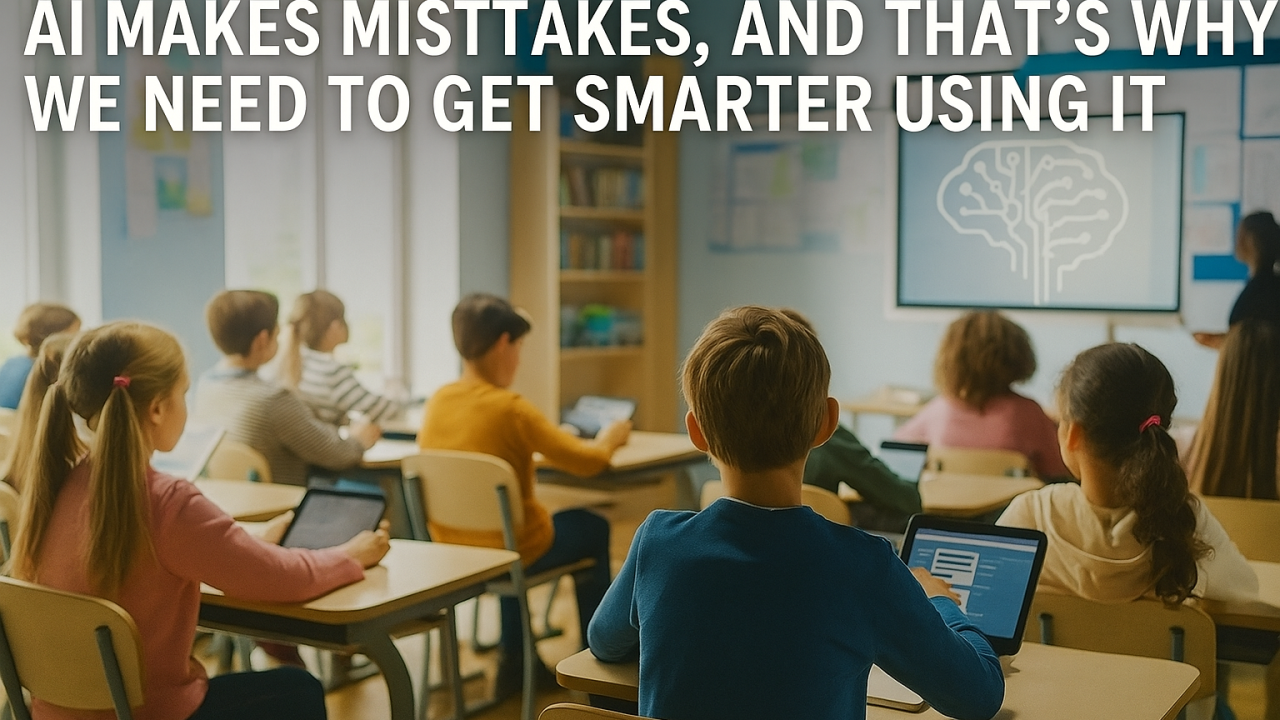
Last week, I had the privilege of speaking for thirty HR professionals from primary schools in Central Netherlands, during a Transvita session on AI and the Future of Work in Education.
We talked about artificial intelligence, but the deeper conversation was about something far more human: how we deal with mistakes.
Education knows this truth: learning means failing forward
In education, we’ve always known that progress comes with trial and error. We tell our students to try again, reflect, improve.
And yet, when it comes to AI, we suddenly expect perfection. One glitch, one inaccuracy, and headlines scream: “AI is unreliable!”
That reaction says more about us than about the technology. Because if there’s one thing we should have learned by now, it’s that imperfection is part of intelligence — human or artificial.
During our session, someone beautifully said:
“AI feels like a senior student — quick, confident, but not yet fully understanding what it’s saying.”
Exactly. AI is not a teacher yet. It’s a learner, just like us.
Two kinds of AI — and two kinds of trust
Let’s make an essential distinction:
- Specialized AI — algorithms trained on curated data for specific purposes: predicting student absenteeism, supporting lesson planning, matching teachers and tasks. When designed ethically, these systems are explainable, measurable, and trustworthy.
- Generative AI — like ChatGPT, Copilot or Gemini — are large language models trained on vast amounts of text. They don’t know; they predict. They make mistakes, but they also open creative doors we couldn’t imagine before.
One type offers precision. The other offers imagination. We need both.
The obsession with “AI errors” misses the point
Recently, the BBC tested over 3,000 prompts across AI systems and found inaccuracies in about 45% of answers. That sounds alarming — until you realize that means how many results were accurate, or at least still very useful.
If any human team answered 3,000 complex news questions correctly 55% of the time, we’d call that impressive.
The question isn’t: “Does AI make mistakes?” It’s: “Does AI help us perform better than we would without it?”
Just like with Google Maps: sometimes it sends you down the wrong street — but no one prefers driving without navigation.
AI, too, can be wrong and still make us right more often.
Let’s build comfort with imperfection
We need to shift our mindset from “Can we trust AI?” to “How can we use AI wisely, knowing it will sometimes fail?”
Because the truth is: AI will always make mistakes. And so will we. But together, we can make fewer.
When teachers, HR professionals, and leaders learn to use AI as a reflective partner — not as an oracle — something beautiful happens. We stop fearing failure and start seeing it as feedback.
AI as a mirror of our humanity
The moment we use AI, we confront our own cognitive biases, shortcuts, and blind spots. AI doesn’t just imitate us — it reveals us.
When an algorithm “hallucinates,” it exposes how easy it is to sound confident and still be wrong. When a model amplifies bias, it reminds us that discrimination was already in the data — because it was already in us.
So maybe AI isn’t just a mirror of intelligence. Maybe it’s a mirror of our collective humility.
HR and education: leading the culture of learning
During the Transvita session, one question echoed through the room: “What role should HR play in renewing education?”
My answer: HR can be the first to model what learning looks like in the age of AI. Not by controlling everything, but by creating psychological safety — the space where people can explore, make mistakes, and still feel trusted.
If teachers are expected to help students learn from errors, then HR must help staff learn from theirs — including the digital ones.
From fear to flow
When I see educators experimenting with AI — testing, doubting, laughing, improving — I see hope. Not blind optimism, but responsible curiosity. A willingness to dance with uncertainty instead of freezing in fear.
This is what innovation really means: Not perfection, but participation. Not control, but co-creation.
My invitation to you
Let’s stop treating AI as an exam we’re grading. Let’s treat it as a partner we’re learning with.
AI makes mistakes — and that’s okay. So do we.
But when we learn together, we accelerate human progress. And maybe that’s the real intelligence we’ve been seeking all along.
Send me a DM or leave a comment if you would like to receive my presentation.