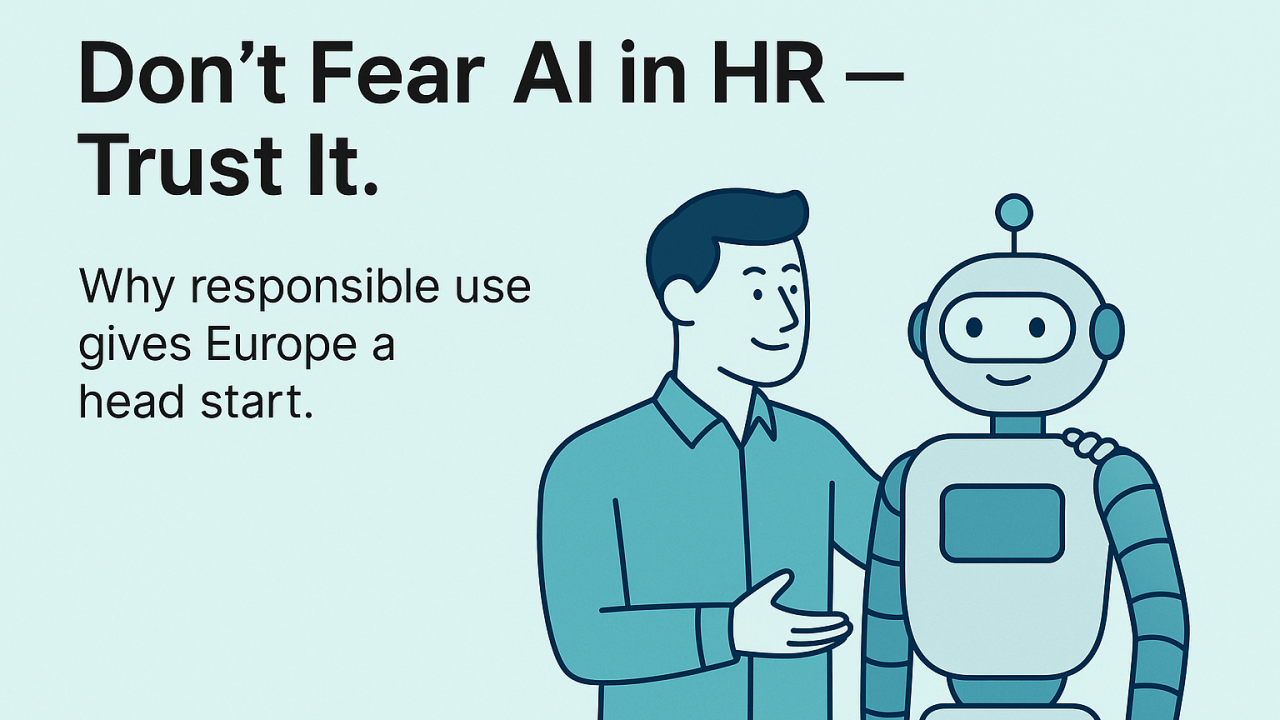
Why responsible use gives Europe a head start.
Every week, I meet HR professionals who ask the same question: How can we use AI without losing control or trust?
The curiosity is huge — but so are the concerns. “What’s allowed and what isn’t?” “Will it replace people?” “What about privacy or bias?”
Here’s the truth: AI in HR can be safe, fair, and incredibly valuable — if you know the guardrails. With the right approach, AI doesn’t take your job. It joins your team: a smart colleague that helps you make faster, fairer, and more informed decisions.
The rules aren’t here to stop you — they help you trust AI
The GDPR and the EU AI Act aren’t designed to block innovation. They exist to create clarity and confidence.
Together, they define how AI can be used responsibly in recruitment, selection, and talent development:
- GDPR governs how personal data is processed — what happens with the data.
- The AI Act defines how AI systems must behave — what happens inside the technology.
In short: GDPR protects people, the AI Act regulates machines.
And that difference matters in practice. Because while the laws may sound abstract, they directly shape how we build and train AI systems in HR. Take the use of data, for example. Even if something looks public — like a LinkedIn profile — it’s not automatically free to use. Only when people know what their data is used for, it’s compliant.
That’s why leading HR tech companies, like 8vance, work exclusively with anonymised and synthetic data — patterns, not persons. It allows us to train our models on skills, not identities, and build fair matches without tracking or profiling anyone.
Europe’s advantage: we take trust seriously
The EU AI Act, adopted in 2024, classifies most HR use cases as “high risk.” That sounds strict, but it’s actually a competitive advantage. Because while many non-European AI vendors still ignore these rules, European companies that comply will be trusted first.
Key requirements under the AI Act include:
- Transparency: being able to explain how AI makes decisions.
- Human oversight: AI supports, humans decide.
- Data quality: fair, representative, robust and explainable models.
👉 That’s not red tape — it’s trust by design. It’s why 8vance’s technology is already built around explainable algorithms, anonymised data, and full auditability.
Practical steps for HR teams
Want to use AI responsibly and effectively? Start here:
1. Build awareness. Talk about what AI already does in your HR processes. Often, it’s more than you think.
2. Run a mini-DPIA. A Data Protection Impact Assessment helps you map risks and show you’re in control.
3. Work with anonymised or synthetic data. You’ll learn patterns without touching personal data.
4. Check for bias. AI can support objectivity, but it needs human reflection.
5. Keep the human in charge. Think of AI as your co-pilot, not your replacement.
6. Document and learn. Record what you do — not for bureaucracy, but to learn what truly works.
The real promise of AI in HR
AI can make HR more efficient and more inclusive. By matching on skills instead of job titles, hidden talent becomes visible. People without the “right” diploma suddenly have a fair shot. And because AI keeps learning from feedback, it can actively strengthen diversity and inclusion.
Those who start now — responsibly — will build the most trusted HR systems tomorrow. Because trust will soon be the true currency of AI.
Final thought
The future of HR isn’t about fear or hype. It’s about confidence, compliance, and collaboration between humans and AI. Those who understand that today — especially in Europe — will lead the global market tomorrow.
👉 Start small. One process. One pilot. One insight. That’s all it takes to see how trustworthy AI can make a real difference.